There are $n$ points $P_1, P_2, \ldots, P_n$ in the plane. VegiCat has $q$ queries for you. Each query gives a point $P$.

For each query, construct a simple polygon using some of the given points as its vertices. The polygon must contain $P$ strictly inside it and have the minimum number of vertices. If no such polygon exists, output $-1$.
A simple polygon is a closed polygonal chain with at least three distinct vertices. Adjacent edges intersect only at their common endpoint, and nonadjacent edges do not intersect.
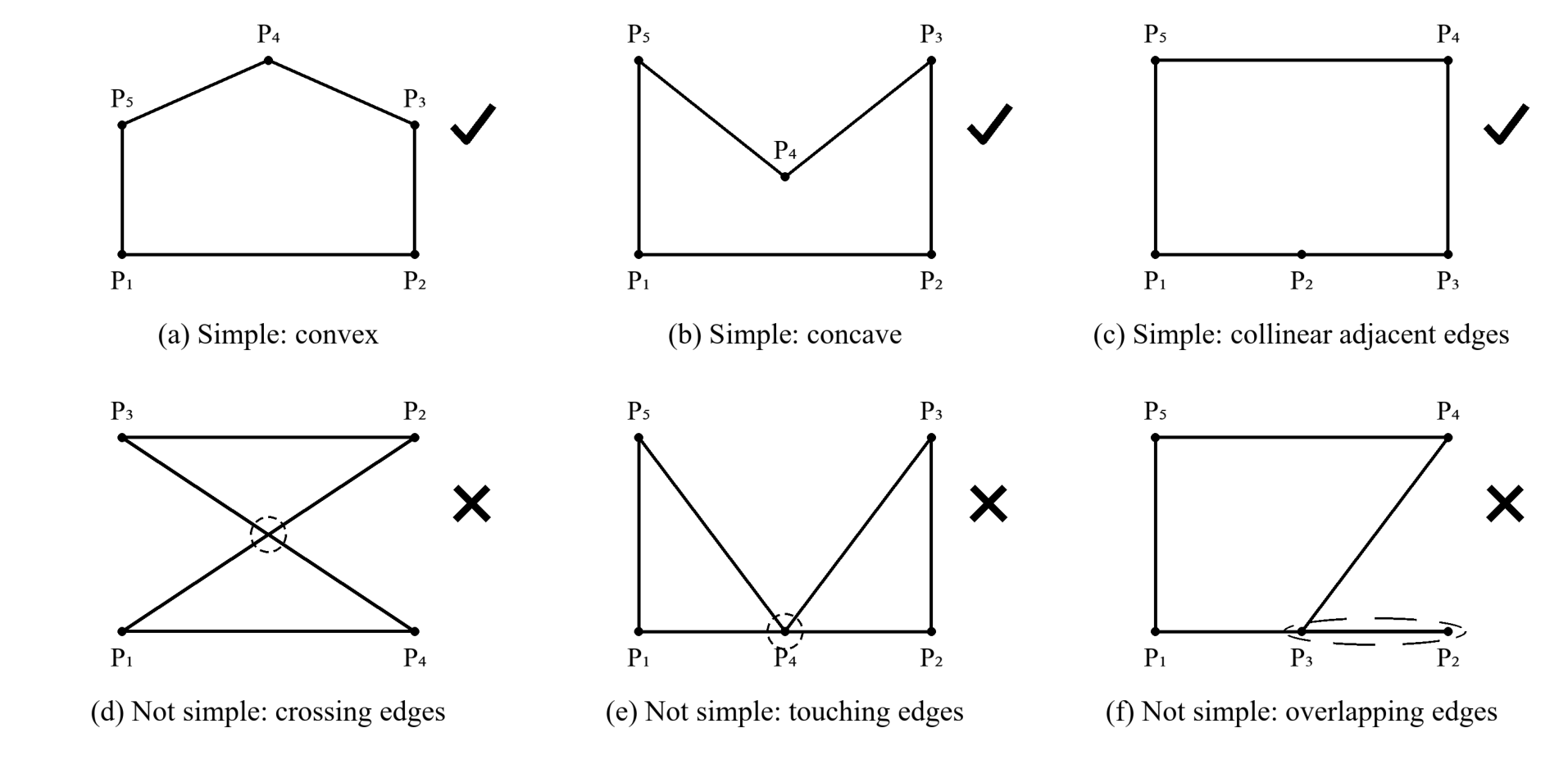
Examples of simple and non-simple polygons
Input
The first line contains an integer $T$ ($1 \le T \le 2 \cdot 10^4$), the number of test cases. The description of the test cases follows.
The first line of each test case contains two positive integers $n$ and $q$ ($3 \le n \le 10^5$, $1 \le q \le 10^5$), representing the number of given points and the number of queries.
The $i$-th of the next $n$ lines contains two integers $x_i$ and $y_i$ ($-10^9 \le x_i, y_i \le 10^9$), the coordinates of $P_i$. It is guaranteed that these $n$ points are pairwise distinct.
Each of the next $q$ lines contains two integers $x$ and $y$ ($-10^9 \le x, y \le 10^9$), the coordinates of the queried point.
It is guaranteed that the sum of $n$ over all test cases does not exceed $10^5$.
It is guaranteed that the sum of $q$ over all test cases does not exceed $10^5$.
Output
For each query, if no polygon satisfying the requirements exists, output one integer $-1$ on a line.
Otherwise, output a polygon with the minimum number of vertices. On the first line, output one integer $m$, the number of vertices.
On the second line, output $m$ integers $a_1, a_2, \ldots, a_m$ ($1 \le a_i \le n$), the indices of the vertices in order. The polygon is $P_{a_1} P_{a_2} \ldots P_{a_m}$. The vertices may be output in either clockwise or counterclockwise order.
The indices must be pairwise distinct, and the output polygon must be simple and contain the queried point strictly inside it. If there are multiple solutions, output any of them.
Examples
Input 1
2
5 1
0 4
-3 0
-3 -3
3 -3
3 0
0 0
3 1
0 4
-3 0
3 0
0 0
Output 1
3
4 1 2
-1
Note
In the first test case, the triangle $P_4 P_1 P_2$ contains the queried point $P = (0, 0)$ strictly inside it. Since a polygon has at least three vertices, this triangle has the minimum number of vertices.
In the second test case, the only possible polygon is the triangle $P_1 P_2 P_3$. The queried point $P = (0, 0)$ lies on the edge $P_2 P_3$, so the answer is $-1$.
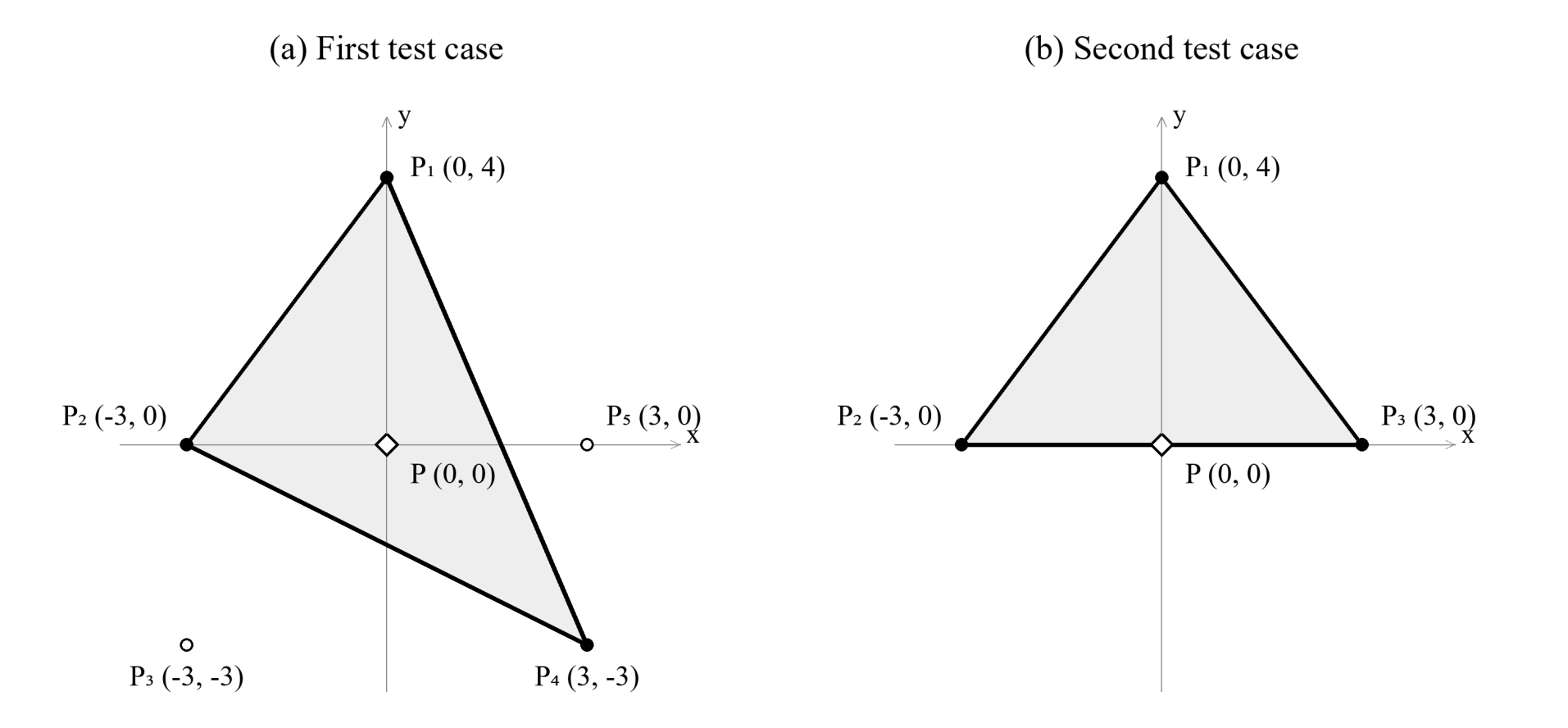
Illustrations of the sample test cases