You are given a board of size $n \times n$, with each of its $n^2$ cells containing one of the numbers $-1$, $0$, or $1$. You are also given four integers $A_L, A_D, A_R$ and $A_U$. We want to draw two polylines:
- one connecting the top-left corner of the board with the bottom-right corner; moving along the edges of the cells only to the right and down,
- and the other connecting the bottom-left corner of the board with the top-right corner, moving only to the right and up.
The two polylines divide the board into four (possibly empty) regions: left, down, right, and up. Check whether there exist two polylines, such that the cells in these four regions sum up to $A_L, A_D, A_R$ and $A_U$, respectively. Print TAK (yes) or NIE (no) for each of the $t$ independent test cases.
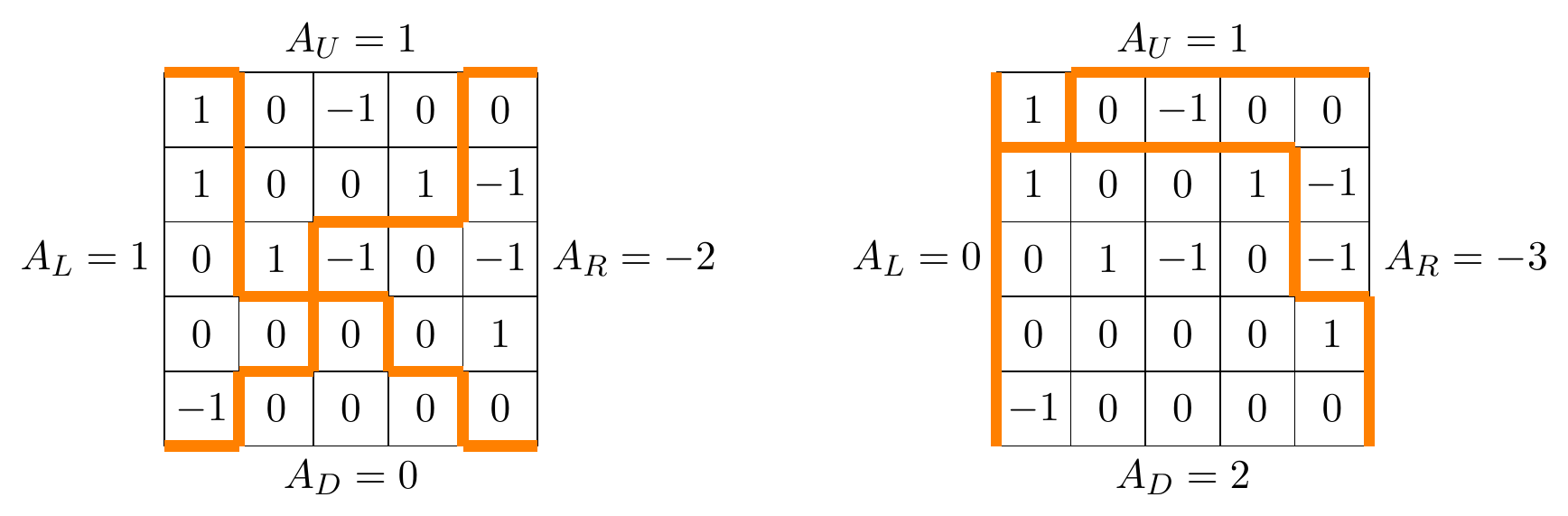
The figures show the same $5 \times 5$ board from the sample test.
The left figure shows a partition into regions with sums $(1, 0, -2, 1)$ (in the order $A_L, A_D, A_R, A_U$). The first polyline can be described by the word RDDDRRDRDR, and the second by RURUURRUUR (where D, U, and R denote moves along edges down, up, and right, respectively). For example, the right region contains 8 cells with a sum $A_R = 0 - 1 - 1 + 0 - 1 + 0 + 1 + 0 = -2$.
The right figure shows a partition into regions with sums $(0, 2, -3, 1)$. The left region is empty, so the sum of its cells is zero. The polylines can be described by the words DRRRRDDRDD and UUUURURRRR.
The same board cannot be partitioned into regions with sums $(-2, 0, 1, 1)$, i.e. $A_L = -2, A_D = 0, A_R = 1, A_U = 1$. Note that the same values, but in a different order, appear in the left figure – the order matters.
Input
The first line of input contains a single integer $t$ ($1 \le t \le 100\,000$), denoting the number of test cases.
The first line of a test case contains five integers $n, A_L, A_D, A_R, A_U$ ($1 \le n \le 2000; -n^2 \le A_L, A_D, A_R, A_U \le n^2$), denoting the side length of the board and the desired sums of the four regions.
Each of the next $n$ lines of the test case describes the board; the $i$-th line contains $n$ integers $a_{i1}, a_{i2}, \dots, a_{in}$ ($a_{ij} \in \{-1, 0, 1\}$), describing the $i$-th row. The total sum of the board is equal to $A_L + A_D + A_R + A_U$.
The total sum of $n^2$ over all test cases does not exceed $4\,000\,000$.
Output
Output exactly $t$ lines – for each test case output the word TAK (yes) if there exist polylines dividing the board into regions with the specified sums, or the word NIE (no) otherwise.
Example
Input
5
5 1 0 -2 1
1 0 -1 0 0
1 0 0 1 -1
0 1 -1 0 -1
0 0 0 0 1
-1 0 0 0 0
5 0 2 -3 1
1 0 -1 0 0
1 0 0 1 -1
0 1 -1 0 -1
0 0 0 0 1
-1 0 0 0 0
5 -2 0 1 1
1 0 -1 0 0
1 0 0 1 -1
0 1 -1 0 -1
0 0 0 0 1
-1 0 0 0 0
2 1 -1 0 1
1 0
-1 1
1 0 0 0 0
0
Output
TAK
TAK
NIE
NIE
TAK
Note
The first three test cases correspond to the examples shown in the statement. They contain the same board and queries for sums $(A_L, A_D, A_R, A_U)$ in order:
- $(1, 0, -2, 1)$, answer
TAK - $(0, 2, -3, 1)$, answer
TAK - $(-2, 0, 1, 1)$, answer
NIE