This problem has an attachment. You can use it to simulate and visualize the movements of the particles.
VegiCat observes particles on a grid with $n$ rows and $n$ columns. The lower-left cell has coordinates $(1, 1)$. The horizontal coordinate increases from left to right, and the vertical coordinate increases from bottom to top. Each particle has a horizontal direction (left or right) and a vertical direction (up or down). At the beginning of each step, each particle adjusts its directions as follows:
- Its horizontal direction is reversed if the next cell in that direction is outside the grid.
- Its vertical direction is reversed if the next cell in that direction is outside the grid.
After these adjustments, a particle at $(x, y)$ produces two child particles:
- One at $(x - 1, y)$ if its horizontal direction is left, or at $(x + 1, y)$ if it is right;
- One at $(x, y - 1)$ if its vertical direction is down, or at $(x, y + 1)$ if it is up.
Both child particles inherit the parent's horizontal and vertical directions. The parent then disappears.
Multiple particles may occupy the same cell at the same time, regardless of their directions. They do not interact or change each other's directions.
At time $0$, there are four particles at $(x_0, y_0)$, with the following direction pairs:
- Right and up;
- Left and up;
- Right and down;
- Left and down.
At each step, all particles simultaneously adjust their directions and then split as described above.
You are given $q$ queries. Each query gives integers $A, B, C$ and a time $t$. For each query, find the number of grid cells $(x, y)$ that satisfy $Ax + By + C = 0$ and contain at least one particle at time $t$.
Input
The first line contains an integer $T$ ($1 \le T \le 10^5$), the number of test cases. The description of the test cases follows.
The first line of each test case contains four integers $n, x_0, y_0, q$ ($2 \le n \le 10^9$, $1 \le x_0, y_0 \le n$, $1 \le q \le 10^5$). The grid has $n$ rows and $n$ columns. The initial cell is $(x_0, y_0)$, and there are $q$ queries.
Each of the next $q$ lines contains four integers $A, B, C$ and $t$ ($|A|, |B|, |C| \le 10^9$, $0 \le t \le 10^9$). This describes a query for the line $Ax + By + C = 0$ at time $t$. It is guaranteed that $A$ and $B$ are not both $0$ simultaneously.
It is guaranteed that the sum of $q$ over all test cases does not exceed $10^5$.
Output
For each query, output one integer on one line: the number of grid cells $(x, y)$ that satisfy $Ax + By + C = 0$ and contain at least one particle at time $t$.
Examples
Input 1
1
6 5 5 4
2 -1 -5 0
1 -1 0 1
11 45 14 2
1 0 -5 3
Output 1
1
0
0
3
Note
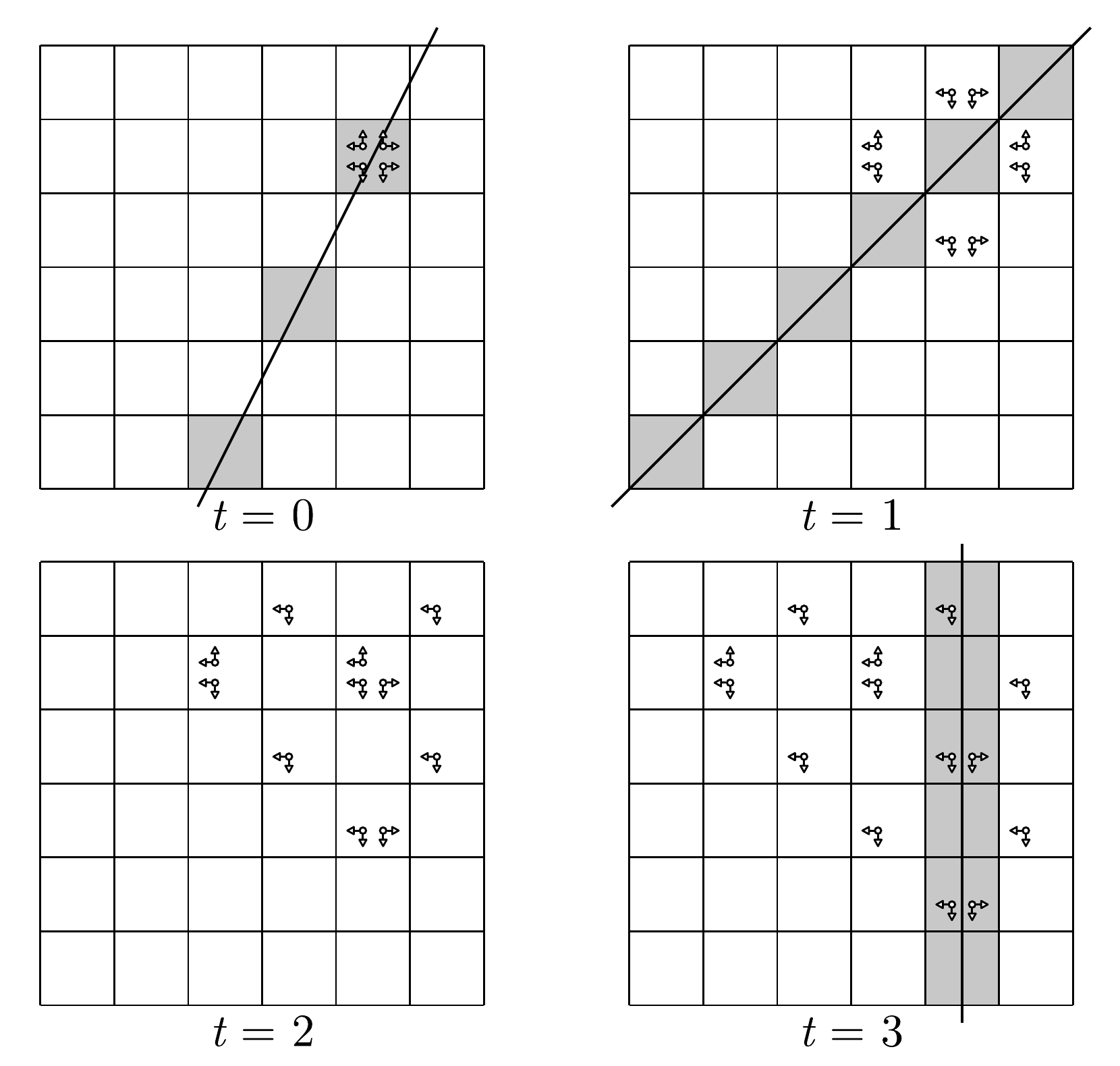
The figure below shows the particle evolution in the sample, as well as the queried straight lines, where the gray cells represent the cells containing integer points through which the straight line passes, and all splitting directions have undergone legality adjustments. Since the third query is too far away from the grid under consideration, the line of the third query is omitted here.
Particles in the same cell with the same direction pair are drawn as a single symbol; multiplicities are omitted.