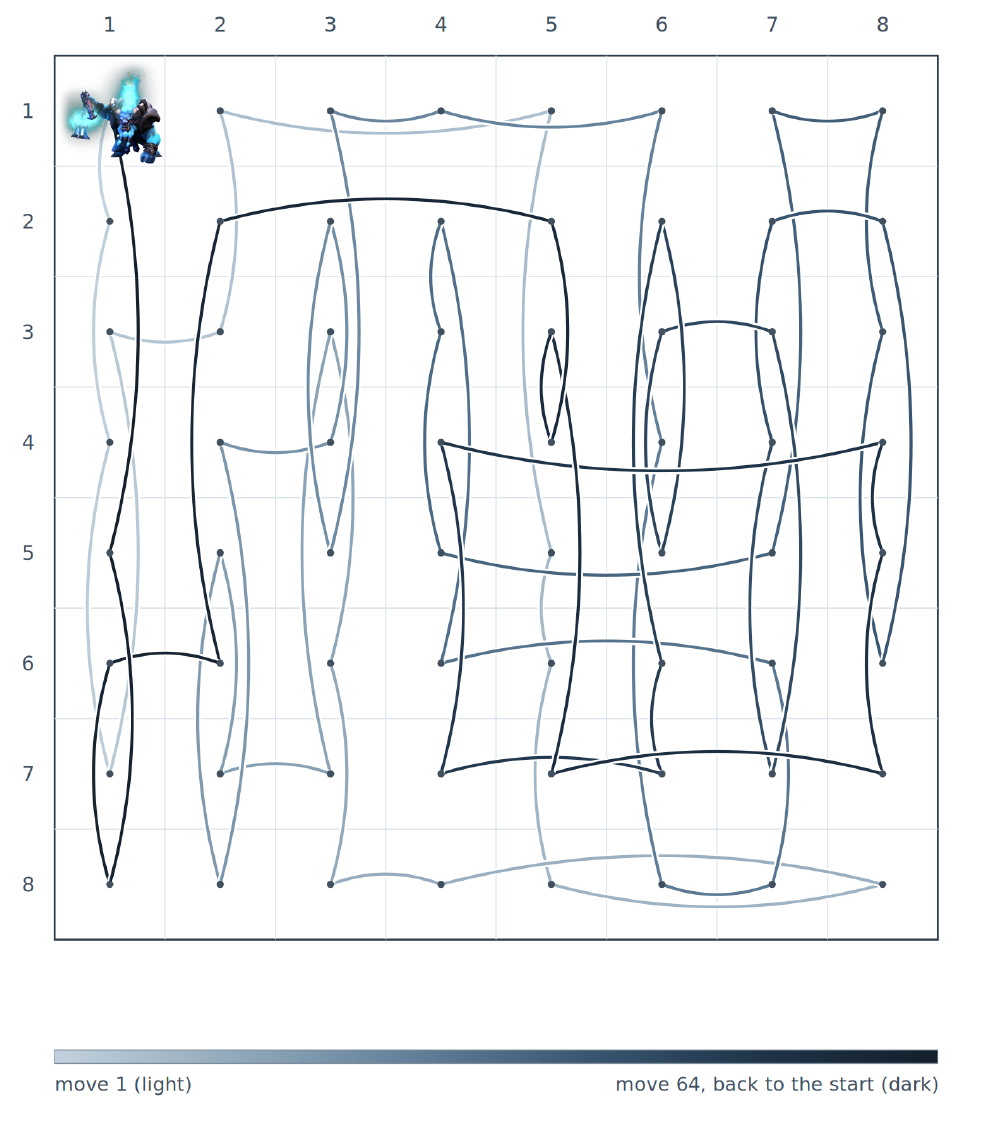
You are given a positive even integer $n$. Consider an $n\times n$ grid whose rows and columns are both numbered from $1$ to $n$. The cell in row $r$ and column $c$ is denoted $(r,c)$.
Your task is to arrange all $n^2$ cells of the grid into a sequence $p_1,p_2,\ldots,p_{n^2}$ in which every cell appears exactly once such that, with the convention $p_{n^2+1}=p_1$, for every $i$ from $1$ to $n^2$, the cells $p_i$ and $p_{i+1}$ lie in the same row or in the same column and satisfy
$$ |r_i-r_{i+1}|+|c_i-c_{i+1}|=((i-1)\bmod 4)+1, $$
where $p_i=(r_i,c_i)$ and $p_{i+1}=(r_{i+1},c_{i+1})$.
In other words, the sequence should be a closed tour of length $n^2$ visiting every cell once, each move is horizontal or vertical, and the move lengths form a sequence $1,2,3,4,1,2,3,4,\ldots$ repeating cyclically, including the final move from $p_{n^2}$ back to $p_1$.
If such a sequence exists, output any one of them.
Input
The first line contains a single even integer $n$ ($4\le n\le 200$).
Output
If no valid sequence exists, print a single line containing NO.
Otherwise, print YES on the first line, and then print $n$ lines containing $n$ integers each. The $j$-th column of the $i$-th row should contain one integer $k$ such that, in your answer, $p_k$ is the cell $(i,j)$.
If there are multiple valid answers, print any one of them.
Examples
Input 1
8
Output 1
YES
1 7 25 26 8 27 37 38
2 60 23 33 59 48 42 41
5 6 16 34 57 46 45 39
3 21 22 52 58 28 43 53
64 19 24 35 9 47 36 54
62 61 15 32 10 49 31 40
4 18 17 51 56 50 44 55
63 20 14 13 11 29 30 12
Note