A valid expression is defined recursively:
xis a valid expression;- if $A$ and $B$ are valid expressions, then $(AB)$ is also a valid expression.
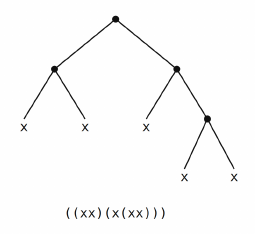
For example, ((xx)(x(xx))) is a valid expression with five occurrences of x. Every valid expression corresponds to a binary tree: each x is a leaf, and each pair of brackets is an internal node whose children are the two subexpressions it encloses.
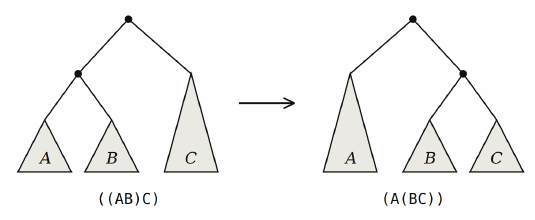
In one operation, you may replace a subexpression of the form $((AB)C)$ with $(A(BC))$, where $A$, $B$, and $C$ are arbitrary valid expressions. In the tree representation, this rotates a single edge.
We say that an expression $u$ can be obtained from an expression $v$ if $u$ can be produced from $v$ by applying zero or more operations. In particular, every expression can be obtained from itself.
You are given an integer $\ell$. The number of valid expressions with exactly $\ell$ occurrences of x is the Catalan number
$$ n=C_{\ell-1}=\frac{1}{\ell}\binom{2\ell-2}{\ell-1}, $$
and all of them are enumerated in lexicographical order as $S_1,S_2,\ldots,S_n$, using the character order $\texttt{(}<\texttt{x}<\texttt{)}$. Here, $\binom{a}{b}=\frac{a!}{b!(a-b)!}$ is the binomial coefficient.
You are also given a permutation $p_1,p_2,\ldots,p_n$ of the integers from $1$ to $n$; the value $p_i$ represents the expression $S_{p_i}$. Count the pairs $(i,j)$ with $1 \le i<j \le n$ such that $S_{p_i}$ can be obtained from $S_{p_j}$.
Input
The first line contains one integer $\ell$ ($1 \le \ell \le 14$).
The second line contains $n=C_{\ell-1}$ integers $p_1,p_2,\ldots,p_n$: a permutation of $1,2,\ldots,n$.
Output
Print one integer: the number of pairs $(i,j)$ such that $1 \le i<j \le n$ and $S_{p_i}$ can be obtained from $S_{p_j}$.
Examples
Input 1
4
3 1 5 2 4
Output 1
3
Note
For $\ell=4$ there are $n=C_3=5$ valid expressions, in lexicographical order: $S_1=$ (((xx)x)x), $S_2=$ ((x(xx))x), $S_3=$ ((xx)(xx)), $S_4=$ (x((xx)x)), $S_5=$ (x(x(xx))).
A single operation turns $S_1$ into $S_2$ or into $S_3$, turns $S_2$ into $S_4$, and turns each of $S_3$ and $S_4$ into $S_5$; no operation applies to $S_5$.
The three pairs that count are $(i,j)=(1,2)$, since $S_3$ can be obtained from $S_1$; $(3,4)$, since $S_5$ can be obtained from $S_2$; and $(3,5)$, since $S_5$ can be obtained from $S_4$.