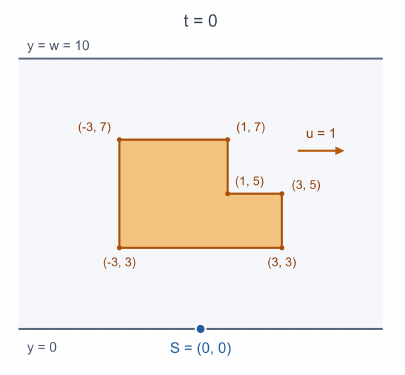
You are about to cross the road, but a car is speeding along it.
In the Cartesian plane, a road of width $w$ extends infinitely in the $x$-direction and occupies the strip $0\le y\le w$. You want to cross it from the lower boundary $y=0$ to the upper boundary $y=w$, while avoiding a car on the road.
The car’s body is represented by a simple polygon with $n$ vertices. At time $t=0$, its vertices are $(x_1,y_1),(x_2,y_2),\ldots,(x_n,y_n)$ in counterclockwise boundary order. The car moves with constant horizontal velocity $u$, so at time $t$ its $i$-th vertex is at $(x_i+ut,y_i)$.
You may move in any direction or wait, but your speed must never exceed $v$. Equivalently, for any two times $0\le t_1\le t_2$, the Euclidean distance between your positions at those times must be at most $v(t_2-t_1)$. At no time may you be strictly inside the car’s body; touching its boundary is allowed.
You are given $q$ independent queries. In the $j$-th query, you start from $(s_j,0)$ at time $t=0$. Find the minimum time needed to reach any point on $y=w$ safely. For every query, the car starts again from the same given configuration at $t=0$; the queries do not affect one another. It can be shown that an answer always exists.
Input
The first line contains an integer $T$ ($1\le T\le5\times10^4$), the number of test cases.
Each test case begins with a line containing four integers $n,w,u,v$ ($3\le n\le5\times10^5$, $1\le w,v\le10^9$, $-10^9\le u\le10^9$): the number of vertices of the car, the width of the road, the car’s horizontal velocity, and your maximum speed, respectively.
The next $n$ lines describe the car at time $t=0$. The $i$-th line contains two integers $x_i,y_i$ ($-10^9\le x_i\le10^9$, $0\le y_i\le w$), the coordinates of its $i$-th vertex. The vertices are given in counterclockwise boundary order and form a simple polygon: non-adjacent edges have no common point, adjacent edges intersect only at their common endpoint, and no three consecutive vertices are collinear.
The next line contains an integer $q$ ($1\le q\le5\times10^5$), the number of queries. Each of the following $q$ lines contains an integer $s_j$ ($-10^9\le s_j\le10^9$), specifying the starting point $(s_j,0)$ for the $j$-th query.
It is guaranteed that both the sum of $n$ and the sum of $q$ over all test cases do not exceed $5\times10^5$.
Output
For each query, output one real number on a separate line: the minimum time needed to reach $y=w$ safely.
Your answer is considered correct if its absolute or relative error does not exceed $10^{-6}$. More precisely, for each value $a$ you output and the corresponding reference value $b$, the requirement is $\frac{|a-b|}{\max(1,|b|)}\le10^{-6}$.
Examples
Input 1
3
6 10 1 3
-3 3
3 3
3 5
1 5
1 7
-3 7
3
0
6
-6
4 20 5 1
-12 2
2 2
2 10
-2 10
2
0
-12
4 8 2 5
-5 0
5 0
5 8
-5 8
2
-3
3
Output 1
3.504497942940
3.333333333333
3.333333333333
20.211324865405
20.000000000000
1.885714285714
2.412409788555
Note
The figure below shows the initial state ($t=0$) for the first query of the first test case in the sample. The orange polygon represents the car, and the blue point $S=(0,0)$ is your starting point. The arrow indicates the car’s direction of motion, with $u=1$.