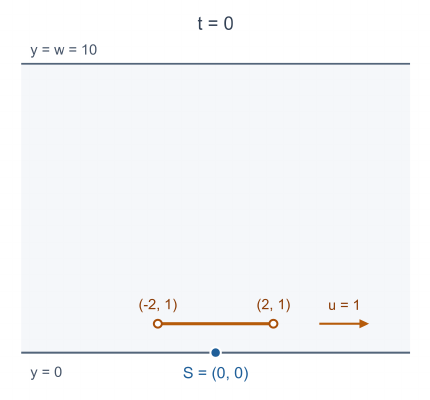
You are about to cross the road, but an e-bike is speeding along it.
In the Cartesian plane, a road of width $w$ extends infinitely in the $x$-direction and occupies the strip $0 \le y \le w$. You start from the fixed point $(0,0)$ and want to reach any point on the upper boundary $y=w$, while avoiding an e-bike on the road.
The e-bike’s body is represented by a line segment parallel to the $x$-axis. At time $t=0$, its endpoints are $(x_1,y_c)$ and $(x_2,y_c)$, where $x_1<x_2$. The e-bike moves with constant horizontal velocity $u$, so at time $t$ its endpoints are at $(x_1+ut,y_c)$ and $(x_2+ut,y_c)$.
You may move in any direction or wait, but your speed must never exceed $v$. Equivalently, for any two times $0 \le t_1 \le t_2$, the Euclidean distance between your positions at those times must be at most $v(t_2-t_1)$. At no time may you be on the e-bike’s segment except at its endpoints; touching either endpoint is allowed.
You start from $(0,0)$ at time $t=0$. Find the minimum time needed to reach any point on $y=w$ safely. It can be shown that an answer always exists.
Input
The first line contains an integer $T$ ($1 \le T \le 2000$), the number of test cases.
Each test case consists of one line containing six integers $w,x_1,x_2,y_c,u,v$ ($2 \le w \le 4\times 10^4$, $-4\times 10^4 \le x_1<x_2 \le 4\times 10^4$, $1 \le y_c \le w-1$, $-4\times 10^4 \le u \le 4\times 10^4$, $1 \le v \le 4\times 10^4$). Here, $w$ is the width of the road, $(x_1,y_c)$ and $(x_2,y_c)$ are the e-bike’s endpoints at time $t=0$, $u$ is the e-bike’s horizontal velocity, and $v$ is your maximum speed.
Output
For each test case, output one real number on a separate line: the minimum time needed to reach $y=w$ safely.
Your answer is considered correct if its absolute or relative error does not exceed $10^{-6}$. More precisely, for each value $a$ you output and the corresponding reference value $b$, the requirement is $\frac{|a-b|}{\max(1,|b|)} \le 10^{-6}$.
Examples
Input 1
3
10 100 110 5 3 1
10 -2 2 1 1 2
10 -2 2 1 -1 1
Output 1
10.000000000
5.286299648
10.250000000
Note
The figure below shows the initial state ($t=0$) of the second test case in the sample. The orange segment represents the e-bike, and the blue point $S=(0,0)$ is your starting point. The arrow indicates the e-bike’s direction of motion, with $u=1$.