There are $n$ Mahou Shoujo sitting in a circle, numbered clockwise from $1$ to $n$. Among them, some are actually Majo.
For the next $n - 3$ days, the following events occur one by one:
- In the night, exactly one Majo wakes up and kills the first living Mahou Shoujo on her left or right (this person could also be a Majo);
- In the morning, everyone wakes up and discovers the dead Mahou Shoujo.
Kamome, as the judge of the Mahou Shoujo, needs to find, after each morning when a dead Mahou Shoujo is discovered, the minimum number of Majo that could have been present on the first day.
Input
Each test contains multiple test cases. The first line contains one integer $t$ ($1 \le t \le 10^5$), indicating the number of test cases. The description of the test cases follows.
The first line contains one integer $n$ ($4 \le n \le 2 \times 10^5$, $1 \le \sum n \le 10^6$), indicating the number of Mahou Shoujo.
The second line contains $n - 3$ integers $p_i$ ($1 \le p_i \le n$, $p_i \ne p_j$ for $1 \le i < j \le n - 3$) indicating the Mahou Shoujo who died on the $i$-th day.
Output
For each test case, output one line containing $n - 3$ integers, indicating the minimum number of Majo that could have been present on the first day after discovering the dead Mahou Shoujo on the $i$-th day.
Examples
Input 1
5
5
1 2
6
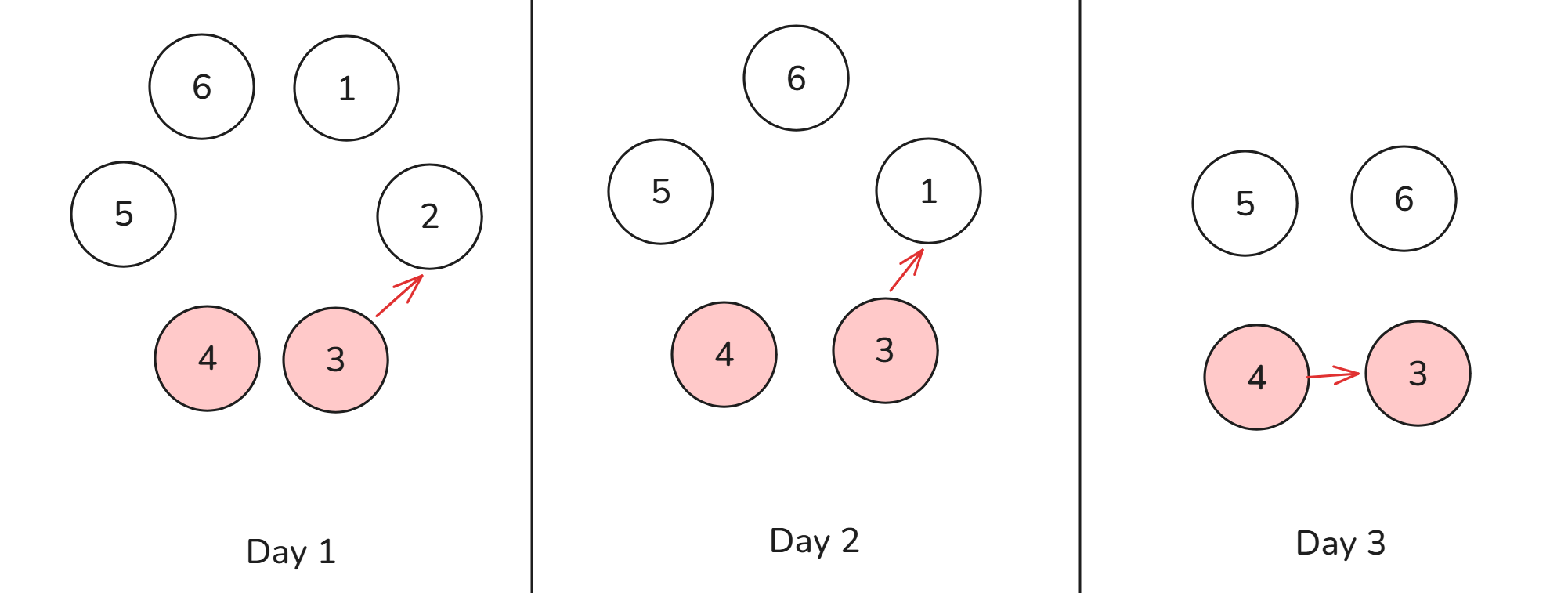
2 1 3
9
1 2 3 4 5 6
10
1 3 5 7 9 2 4
10
2 5 1 8 10 9 4
Output 1
1 1
1 1 2
1 1 1 1 1 1
1 1 2 2 3 3 3
1 2 2 3 3 3 3
Note
For the second test case, on the third day, at least $2$ Majo could have been present on the first day. A possible example is $3$ and $4$ being the Majo, where $3$ kills $2$ on the first day, $3$ kills $1$ on the second day, and $4$ kills $3$ on the third day.