This is an interactive problem.
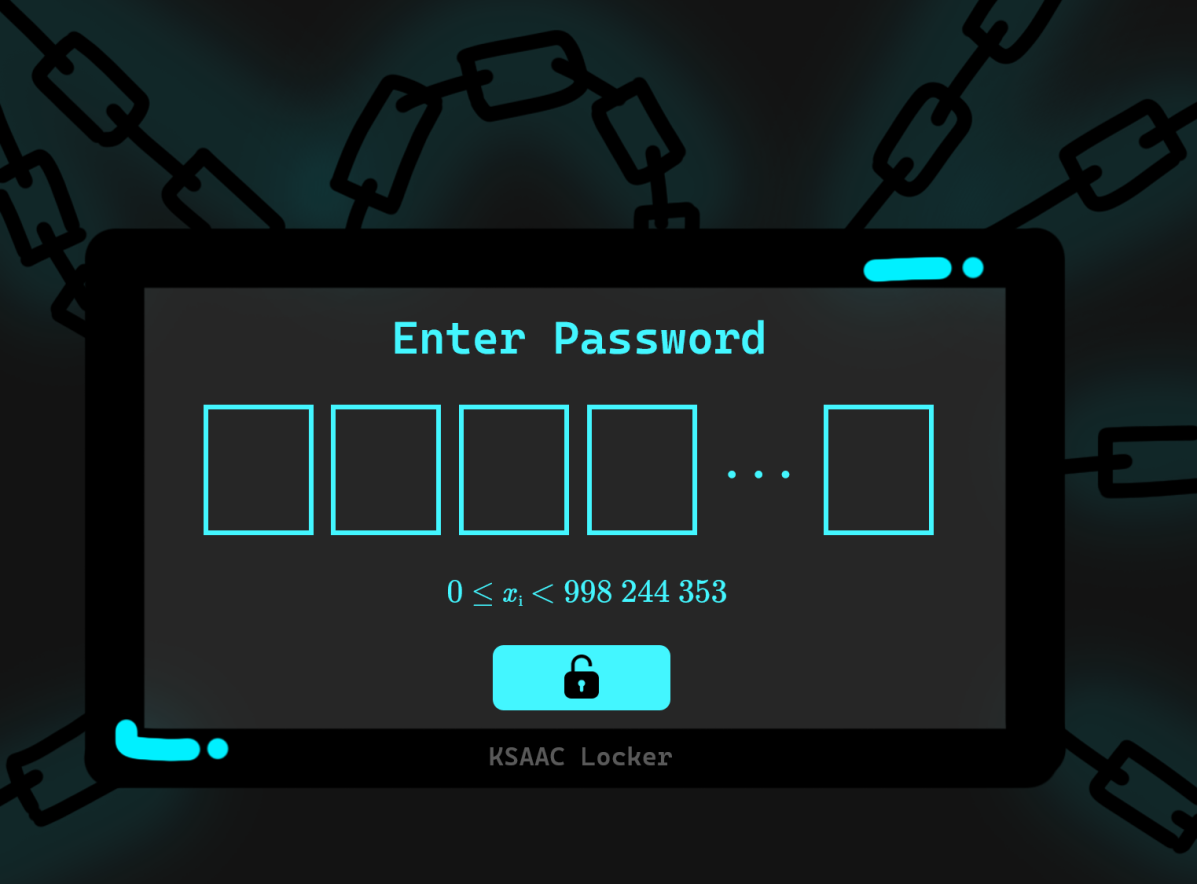
Hanbyeol and Woobin have been assigned to the same dormitory room. However, Woobin, who was embarrassed to share the room with Hanbyeol, installed a passcode device on the door before Hanbyeol came in. To unlock the device, Hanbyeol needs to find $N$ integers $x_{1}, x_{2}, \cdots, x_{N}$ that satisfy $0 \leq x_{i} < 998\,244\,353$. However, the tsundere Woobin provided the following function to assess Hanbyeol's programming skills. Hanbyeol can determine the function value $f(a_{1}, a_{2}, \cdots, a_{N})$ after choosing $N$ desired integers $a_{1}, a_{2}, \cdots, a_{N}$.
Let $\mathbb{M}$ be the set of all integers $x$ such that $0 \leq x < 998\,244\,353$. The function $f: {\overbrace{\mathbb{M} \times \mathbb{M} \times \cdots \times \mathbb{M}}^{N\text{ times}}} \rightarrow \mathbb{M}$ is defined as follows: $$f(a_{1},a_{2},\cdots,a_{N})=(a_{1}x_{1}+a_{2}x_{2}+\cdots+a_{N}x_{N}) \bmod 998\,244\,353$$
However, the function can only be used up to $N$ times, and all the variables $a_{1}, a_{2}, \ldots, a_{N}$ used in all the function operations must be different. In other words, if the function is used $k$ times, all $kN$ arguments must be different.
Now, let's find the passcode and surprise Woobin.
Interaction
Your program should interact with the interactor through standard input and standard output as follows.
First, an integer $N$ is given on the first line of the input.
Upon outputting the following query, the value of $f(a_{1},\cdots,a_{N})$ is given on the next line. This query can be used up to $N$ times.
?$a_1$ $a_2$ $a_3$ $\cdots$ $a_N$ (where $0 \leq a_{i} < 998\,244\,353$)
You can submit the password by outputting the following query. The program must terminate immediately after outputting this query.
!$x_1$ $x_2$ $x_3$ $\cdots$ $x_N$ (where $0 \leq x_{i} < 998\,244\,353$)
For each test case, if the submitted password is correct, you will receive Accepted; if it is incorrect, you will receive Wrong Answer. However, unexpected results may happen if you do not print the solution through proper interactions in the limitations of the problem provided.
Constraints
- $2 \leq N \leq 2500$
Scoring
| No. | Points | Constraints |
|---|---|---|
| $1$ | $10$ | $N \leq 100$ |
| $2$ | $90$ | No additional constraints |
Examples
Input 1
2

4

6
Output 1
? 1 3

? 2 4

! 1 1
Note
You must flush the output immediately after printing something. To flush you can use:
- C ---
fflush(stdout) - C++ ---
std::cout.flush() - Python ---
sys.stdout.flush() - Java ---
System.out.flush() - read the documentation for other languages.
Also, note that the empty lines in the example input and output are for the sake of clarity, and do not occur in the real interaction.