You are given integers $H, W, A, B, C, D$.
There is a grid with $H$ rows and $W$ columns. The cell in the $i$-th row from the top and the $j$-th column from the left is called cell $(i, j)$.
Each cell is colored either white or black. Cell $(i, j)$ is black if and only if $A \le i \le B$ and $C \le j \le D$; otherwise, it is white.
You place lights on some of the white cells of this grid. A light placed on a white cell $(i, j)$ illuminates all white cells that satisfy both of the following conditions:
- They are in the same row or the same column as cell $(i, j)$.
- There is no black cell between cell $(i, j)$ and that cell.
A placement of lights is said to be valid if it satisfies the following two conditions:
- Every white cell is illuminated by at least one light.
- No cell that has a light is illuminated by any other light.
Find the number of valid placements of lights, modulo $998244353$.
Input
The input is given in the following format:
H W A B C D
- All input values are integers.
- $1 \le A \le B \le H \le 5 \times 10^5$
- $1 \le C \le D \le W \le 5 \times 10^5$
- $(A, B) \ne (1, H)$
- $(C, D) \ne (1, W)$
Output
Output the answer.
Examples
Input 1
3 3 2 2 2 2
Output 1
7
Input 2
2 3 1 1 1 2
Output 2
3
Input 3
500000 500000 100000 200000 100000 250000
Output 3
360665510
Note
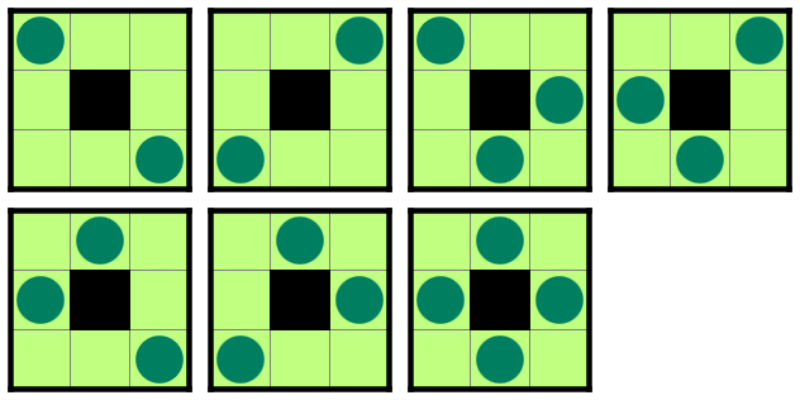
In the first example, there are exactly $7$ valid placements of lights. Cells with lights and white cells illuminated by lights are shown in green in the figures.
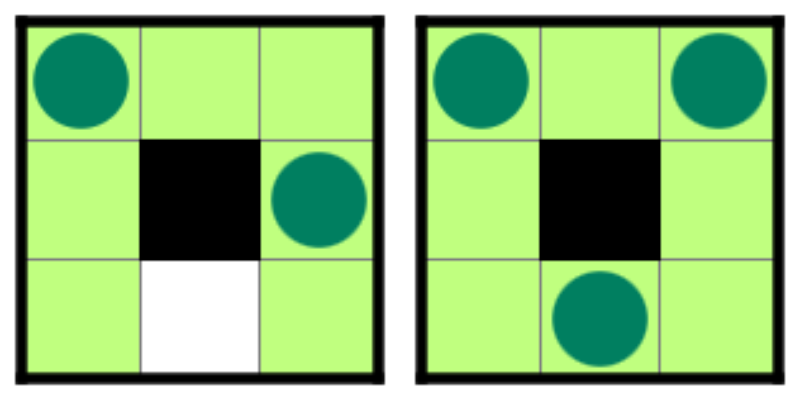
Some placements do not satisfy the conditions: in the left case, there exists at least one white cell that is not illuminated by any light; in the right case, there is a white cell with a light that is illuminated by another light. Both cases are invalid.