You are given a string $S$ of length $N$ consisting of the digits $1, 2, \dots, 9$.
Consider a triangular pyramid made up of a total of $\frac{N(N+1)}{2}$ blocks.
The pyramid is divided into $N$ layers, numbered $1, 2, \dots, N$ from top to bottom. Layer $i$ ($1 \le i \le N$) contains $i$ blocks arranged in a single horizontal row from left to right. Each block has a string written on it. Let $C_{i,j}$ denote the string written on the $j$-th block from the left ($1 \le j \le i$) in layer $i$.
The strings $C_{i,j}$ satisfy the following conditions:
- If $i = N$, then $C_{i,j}$ is the string of length $1$ consisting of the $j$-th character of $S$.
- If $1 \le i < N$, then $C_{i,j}$ is the concatenation of $C_{i+1,j}$ and $C_{i+1,j+1}$, in this order.
Interpret $C_{1,1}$ as a decimal integer, and compute its value modulo $998244353$.
Input
The input is given in the following format:
N
S
- $N$ is an integer.
- $1 \le N \le 2 \times 10^5$.
- $S$ is a string of length $N$ consisting of the digits $1, 2, \dots, 9$.
Output
Output the answer.
Examples
Input 1
4
8192
Output 1
81191992
Input 2
1
5
Output 2
5
Input 3
14
11123455678999
Output 3
913063116
Note
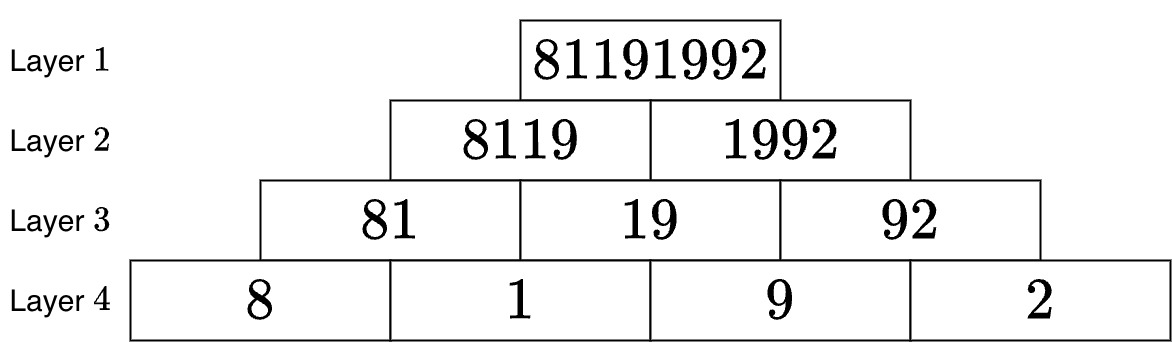
In the first example, $S = 8192$. By constructing the pyramid according to the rules, we obtain $C_{1,1} = 81191992$.
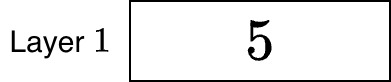
In the second example, $S = 5$. The pyramid consists of a single block, and $C_{1,1} = 5$.