Chinese chess (Xiangqi) is a popular game enjoyed by people of all ages. This was even noted at the 49th ICPC World Finals.
Photo taken in the 49th ICPC World Finals
Today, having just learned the rules of Xiangqi, you challenge the grandmaster Nanani. The grandmaster does not want to overwhelm you, so you will play a simplified version of the game with the following rules:
- The chessboard has $9$ columns and $10$ rows. Only two pieces are placed: a Knight and a Rook. If a piece is at column $x$ and row $y$, we denote its position by $(x, y)$. Both the Rook and the Knight must stay within the chessboard and may not move outside it.
- The two players take turns moving their pieces. If, after a player's move, their piece moves to the exact position of the opponent's piece, it is said that they have "captured" the opponent's piece, and the game ends.
- The moving rules for the Knight are as follows:
- It can move from $(x_N, y_N)$ to $(x_N + 2, y_N \pm 1)$, if $(x_N + 1, y_N)$ is empty.
- It can move from $(x_N, y_N)$ to $(x_N - 2, y_N \pm 1)$, if $(x_N - 1, y_N)$ is empty.
- It can move from $(x_N, y_N)$ to $(x_N \pm 1, y_N + 2)$, if $(x_N, y_N + 1)$ is empty.
- It can move from $(x_N, y_N)$ to $(x_N \pm 1, y_N - 2)$, if $(x_N, y_N - 1)$ is empty.
- The Rook can move to any other position in the same row or column, but cannot jump over the other piece.
- Each player must move their piece on their turn. It can be proven that the current player always has a way to move their piece in any situation.
The grandmaster controls the Knight, and you control the Rook, with the grandmaster moving first. Does the Rook have a strategy such that, no matter how the Knight responds, the Rook can capture the Knight in finitely many moves without being captured by the Knight?
Input
There are multiple test cases. The first line of the input contains an integer $T$ ($1 \le T \le 8010$) indicating the number of test cases. For each test case:
The first and only line contains four integers $x_N$, $y_N$, $x_R$ and $y_R$ ($1 \le x_N, x_R \le 9$, $1 \le y_N, y_R \le 10$), where $(x_N, y_N)$ is the initial position of the Knight, and $(x_R, y_R)$ is the initial position of the Rook. It is guaranteed that the initial positions of the two pieces are different.
Output
For each test case output one line. If such a strategy exists for the Rook, output YES, or otherwise, output NO.
Examples
2
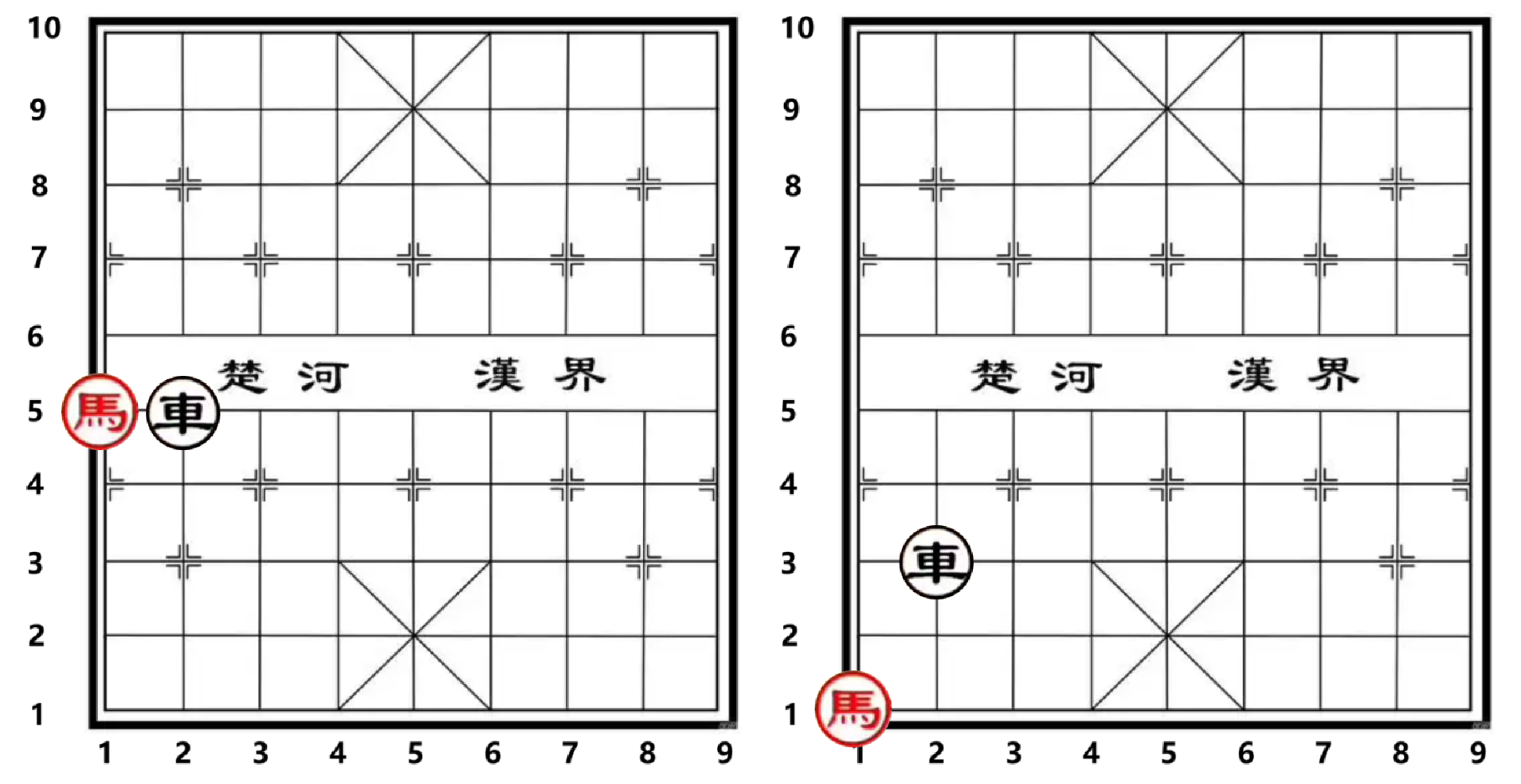
1 5 2 5
1 1 2 3
YES
NONote
The sample test cases are shown as follows. Red pieces represent Knight, and black pieces represent Rook.