Ein Polygon $P_1$ enthält ein Polygon $P_2$, wenn jeder Punkt innerhalb oder auf dem Rand von $P_2$ auch innerhalb oder auf dem Rand von $P_1$ liegt. Ein Polygon $P_1$ enthält $P_2$ strikt, wenn jeder Punkt innerhalb oder auf dem Rand von $P_2$ strikt im Inneren von $P_1$ liegt (kein Punkt auf dem Rand).
Panda hat zwei konvexe Polygone, $P$ und $Q$. Das Polygon $P$ hat $n$ Eckpunkte und das Polygon $Q$ hat $m$ Eckpunkte. Es wird garantiert, dass $Q$ strikt in $P$ enthalten ist.
Du sollst Panda dabei helfen, die Gesamtanzahl der Möglichkeiten zu bestimmen, genau $3$ verschiedene Eckpunkte aus dem Polygon $P$ auszuwählen, die ein Dreieck $P_\Delta$ bilden, sodass $P_\Delta$ das Polygon $Q$ (nicht unbedingt strikt) enthält.
Eingabe
Die erste Zeile enthält eine einzelne ganze Zahl $T$ ($1 \le T \le 1000$), die Anzahl der Testfälle.
Für jeden Testfall enthält die erste Zeile eine ganze Zahl $n$ ($3 \le n \le 3 \cdot 10^5$), die Anzahl der Eckpunkte von $P$.
In den nächsten $n$ Zeilen enthält jede Zeile zwei ganze Zahlen $x, y$ ($|x|, |y| \le 10^9$), die Koordinaten der Eckpunkte von $P$. Es wird garantiert, dass die Eckpunkte gegen den Uhrzeigersinn angegeben sind und keine drei Eckpunkte kollinear sind.
Die nächste Zeile enthält eine ganze Zahl $m$ ($3 \le m \le 3 \cdot 10^5$), die Anzahl der Eckpunkte von $Q$.
In den nächsten $m$ Zeilen enthält jede Zeile zwei ganze Zahlen $x, y$ ($|x|, |y| \le 10^9$), die Koordinaten der Eckpunkte von $Q$. Es wird garantiert, dass die Eckpunkte gegen den Uhrzeigersinn angegeben sind, keine drei Eckpunkte kollinear sind und $Q$ strikt in $P$ enthalten ist.
Es wird garantiert, dass sowohl $\sum n$ als auch $\sum m$ über alle Testfälle hinweg $5 \cdot 10^5$ nicht überschreiten.
Ausgabe
Gib für jeden Testfall eine ganze Zahl in einer einzelnen Zeile aus, die die Antwort darstellt.
Beispiele
Eingabe 1
3
6
-5 0
-4 -4
0 -4
3 1
2 5
-3 4
4
-2 1
-2 0
0 0
0 1
6
-5 0
-4 -4
0 -4
3 1
2 5
-3 4
4
-1 1
-1 0
0 0
0 1
7
1 -3
4 -1
5 0
1 4
0 4
-1 0
0 -2
3
0 0
2 0
0 2
Ausgabe 1
2
4
6
Hinweis
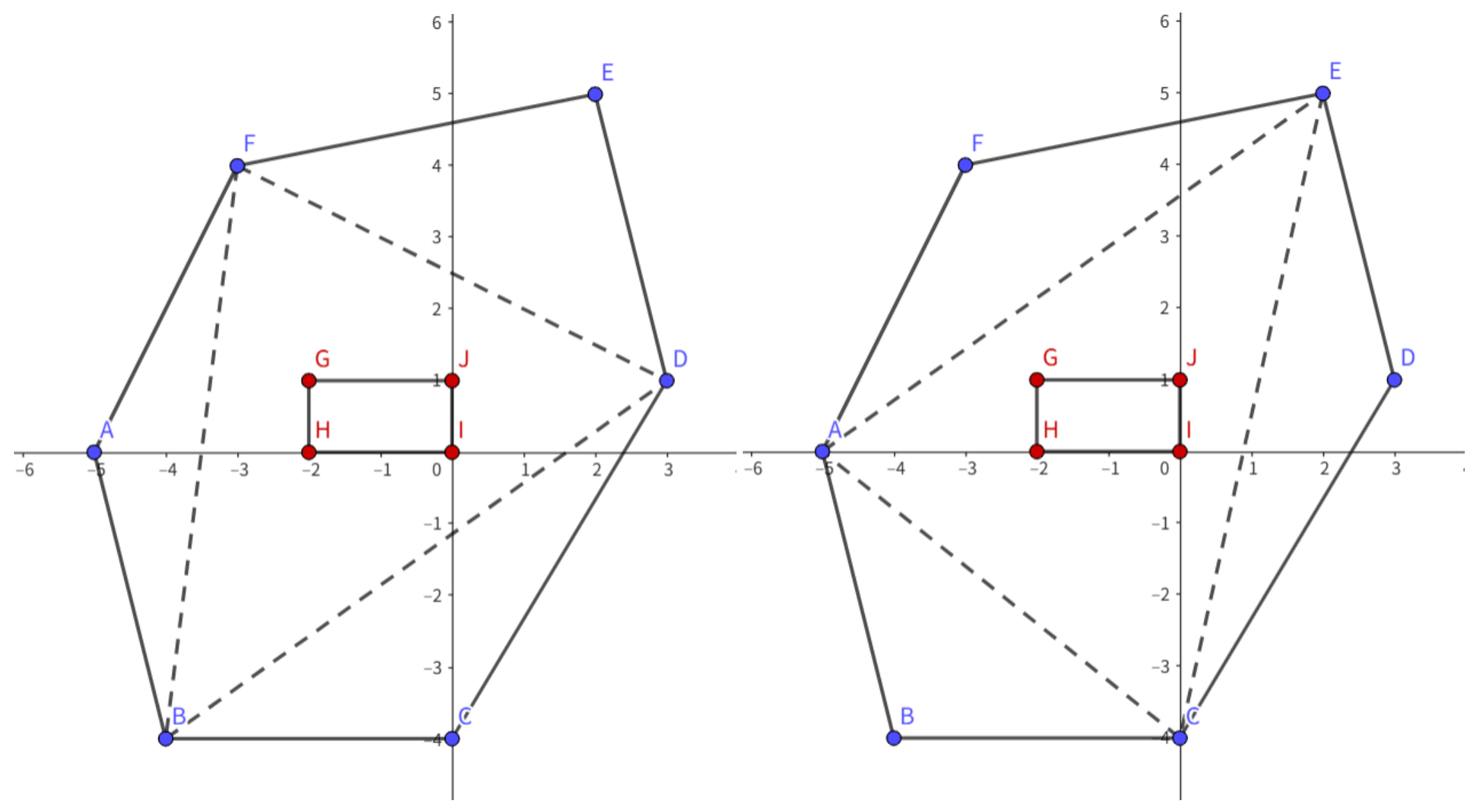
Für das erste Beispiel ist, wie in der Abbildung gezeigt, das Polygon $P$ gleich $ABCDEF$ und das Polygon $Q$ gleich $GHIJ$. Die Dreiecke $\triangle ACE$ und $\triangle BDF$ sind diejenigen, die $Q$ enthalten.